Beyond Urban Air Taxis: The Challenges Shaping the Future of eVTOL
Imagine two paths leading to the future of flight.
One shines bright — the promise of early eVTOLs. Sleek, futuristic, and full of ambition, they captured the world's imagination with short, fifteen-minute hops between gleaming rooftop vertiports. They looked revolutionary, yet served the few, not the many.
The other path is quieter — and broader. It is the one where advanced air mobility becomes part of daily life: connecting rural hospitals, moving supplies between manufacturing hubs, reaching flood-hit regions when roads fail. It is not about luxury or spectacle. It is about connection, service, and progress. That is the path that will define the real future of flight.
To understand how we reach it, we must look honestly at why the first wave of eVTOL innovation lost altitude. The ideas were bold, yet the vision was narrow. Real change starts by understanding where the limits are — and how to move beyond them.
Seeing the Gaps — The "Three Walls" Holding Back eVTOL Progress
The first generation of eVTOL aircraft proved what was possible, yet also what was not. Most were engineered for the hover, not the haul. They could sprint, yet not sustain. Sustainable aviation, in every sense of the word, depends on endurance.
Across countless prototypes and promises, three barriers consistently stand in the way — three "walls" the industry must climb before air mobility can truly take off. These challenges are shaped not only by technology, but also by the realities of infrastructure, policy, and geography, particularly in regions like the UK and Europe, where regulatory landscapes and operational environments present distinct demands.
Wall 1: The Invisible 300-Mile Gap
Everyone talks about the five-mile urban commute. Yet what about the 200-mile supply chain? Between NHS hospitals, manufacturing sites, and rural communities stretches a vital corridor: fifty to three hundred miles long. This is where economic life happens, and where most electric aircraft simply cannot operate. A battery designed for a short city hop will not cross a region.
"The biggest prize is not flying over traffic — it is flying between the regions that make the country run."
That is where sustainable aviation and regional progress meet — in the quiet, practical corridors of everyday life.
Even if distance were solved, another challenge rises closer to home: the city itself.
Wall 2: The Constrained City
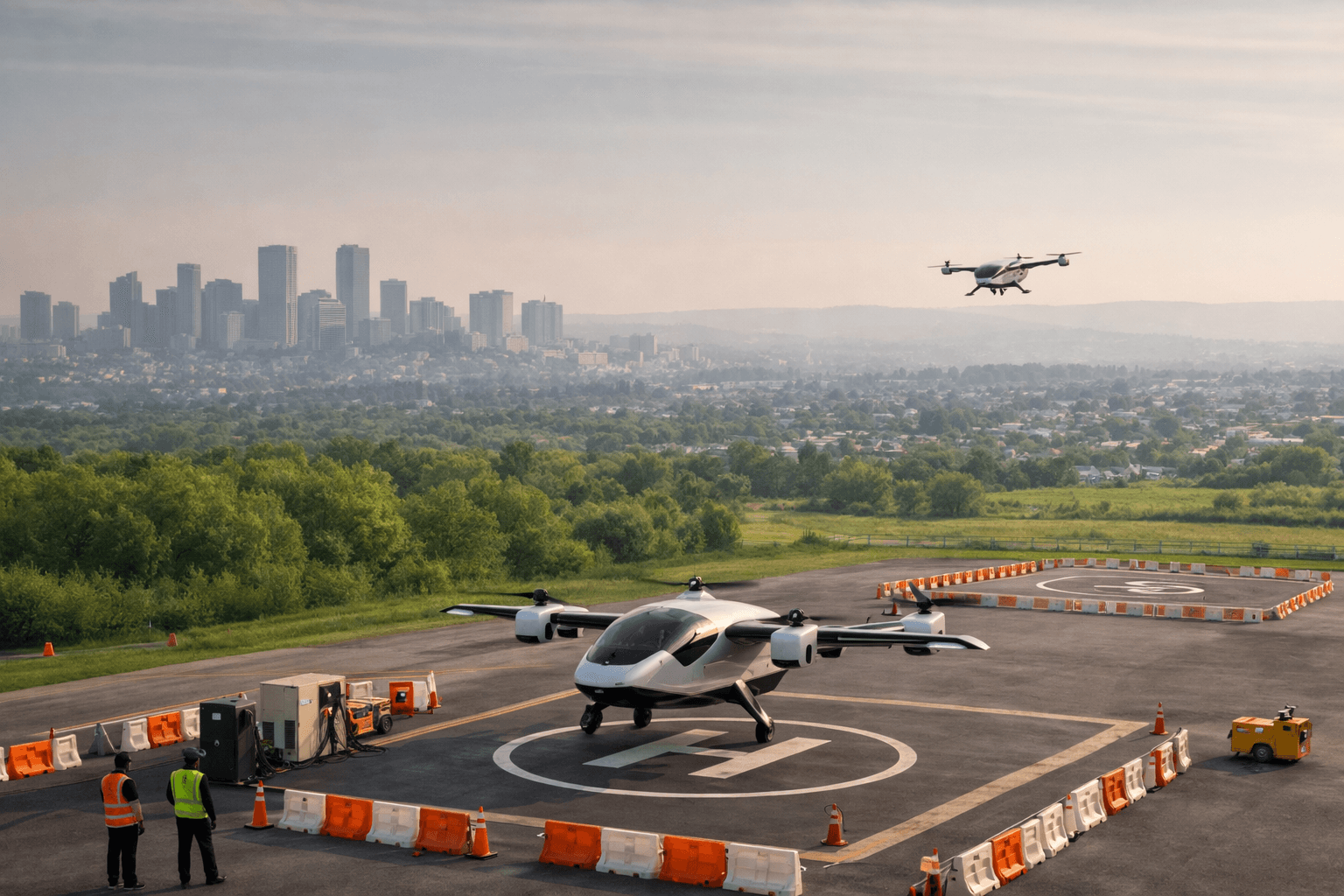
Look up in any major city. There is no spare acre waiting for a futuristic vertiport. Most current eVTOL designs rely on large, purpose-built landing zones. They appear efficient on paper yet collide with reality: land is scarce, noise is restricted, and infrastructure is expensive. One cannot scale a network when every new landing pad costs a fortune. The future does not need more concrete — it needs smarter aircraft. Real progress will not come from building new cities in the sky, but from integrating quietly and intelligently into those that already exist. Yet space is not the only barrier. Sometimes, the hardest walls are those written in regulation.
Wall 3: The Local Rulebook
Aerospace is not just one market but many. Each region follows its own pathway to certification, safety, and sustainability. Yet many current eVTOL programmes begin with a single regulatory framework in mind, later adapting their designs for other jurisdictions. In an industry built on precision, that kind of reconfiguration does not just take time — it adds complexity.
"Certification is not a hurdle — it is a design parameter."
Designing with multiple standards in mind from day one — especially within the UK and Europe — is not just smart engineering. It is alignment: with local safety frameworks, with evolving net-zero requirements, and with the coming shift towards hybrid-electric and hydrogen propulsion.
Each of these walls — distance, infrastructure, and regulation — reflects the same underlying challenge: an industry often driven by short-term spectacle rather than long-term integration. The eVTOL revolution will not succeed by dazzling cities; it will succeed by connecting them.
These are not just engineering challenges — they shape how societies move, how economies link, and how people access opportunity. The impact of these limits reaches far beyond technology itself.
Taking Flight Where It Matters Most
The next era of flight will not be defined by how far technology can go — but by how well it connects people, places, and progress.
What comes next is not about flying over traffic — it is about reaching the regions that too often go unseen. It is about aircraft designed not just to hover, but to help.
Clean, regional aviation is within reach. Yet getting there means designing for distance, adapting to real infrastructure, and aligning innovation with the world as it is — not as we wish it to be.
This is how advanced air mobility becomes more than a breakthrough in engineering — it becomes a step forward in how we live, move, and respond.